

In 1130 Roger II had himself crowned King of Sicily and did something no European ruler had done before: he put Arab, Byzantine and Latin craftsmen to work together, on the same buildings. The result — red domes on Latin churches, gold Byzantine mosaics beneath muqarnas ceilings painted by Arab artists, inscriptions in three languages — exists nowhere else in Europe. Since 2015 it has been a UNESCO World Heritage site: nine monuments across Palermo, Monreale and Cefalù. This is the practical guide to seeing them without getting lost or standing in the wrong queue.
Why it's unique (in two minutes)
The Normans conquered a Sicily that had been an Arab emirate for two centuries, with a strong Greek-Byzantine presence. Instead of erasing what they found, they integrated it: the Norman kings kept the Arab administrators, the Byzantine mosaicists, the Latin jurists. The art that came out of it isn't a sum of styles but a new language — and it lasted barely a century, which makes it all the more precious.
The city stops, in the right order
1. Cappella Palatina and the Norman Palace
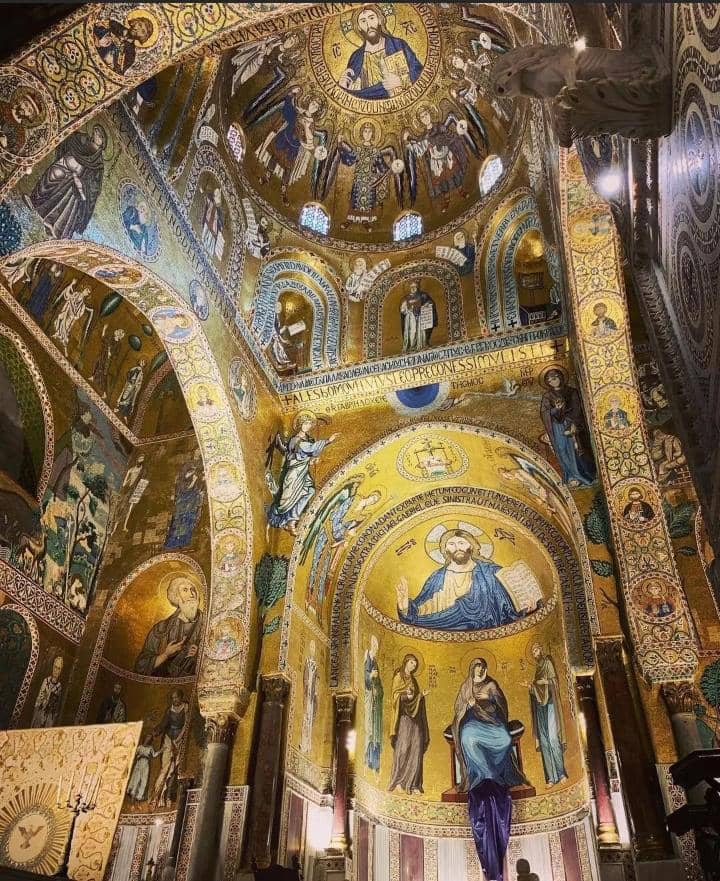
The absolute masterpiece: Roger II's court chapel, entirely clad in gold mosaics, under a wooden muqarnas ceiling unique in the Christian world. Go at opening time (buy your ticket online the night before): by mid-morning cruise groups fill the nave. Note: when the Sicilian Regional Assembly is in session some palace rooms close, but the chapel stays open.
2. San Giovanni degli Eremiti
Five minutes on foot: five red domes over a bare little church, with a cloister and a citrus garden. Half an hour is enough, and it's the perfect counterpoint to the gold of the Palatina.
3. The Cathedral
A palimpsest: Norman basilica, then Gothic, then Neoclassical, built over a mosque that had itself been a basilica. Inside are the imperial tombs of Roger II and Frederick II; the treasury and the rooftops are separate tickets, and the rooftop walk gives you one of the best views in the city.
4. Martorana and San Cataldo
Side by side on Piazza Bellini. The Martorana holds the city's finest Byzantine mosaics (including the only mosaic portrait of Roger II); San Cataldo, with its three red domes and bare interior, has barely changed since 1154. Two small tickets, half an hour each.
5. The Zisa
Outside the centre (a bus ride or a 25-minute walk): the kings' summer palace, pure Arab language — a fountain hall, muqarnas niches, and a passive-cooling system centuries ahead of its time. It now houses the Islamic art museum. Worth the detour precisely because almost nobody makes it.
Monreale: the grand finale
Monreale Cathedral, half an hour by bus (the 389 from Piazza Indipendenza), is the summation of it all: over 6,000 square metres of mosaics crowned by the most famous Christ Pantocrator in the West, and a cloister of 228 columns, no two alike. Mind the schedule: it closes in the middle of the day for services. Go early morning or mid-afternoon. Or make a full day of it: our Monreale, Borgo Parrini and Cala Muletti tour leaves from Palermo and pairs the cathedral with the sea.
How to plan it: two sensible days
- Day 1: Palatina at opening → San Giovanni degli Eremiti → Cathedral → Piazza Bellini in the afternoon.
- Day 2: Monreale in the morning → the Zisa on the way back.
- Tickets: sold separately, monument by monument; only the Palatina genuinely needs booking online. Total budget: €40–50 per person for the whole route.
- Dress: these are working churches — shoulders and knees covered.
If you want the story behind the stones — who these kings were, why they tolerated three religions, what the inscriptions say — our cultural experiences include guided tours of the Arab-Norman route with local guides. And to see the red domes from above, read our guide to Palermo's secret terraces.

